.jpg)
Best UVB lamps for vitiligo and psoriasis (UK): home phototherapy lamps compared
Searching for the best UVB lamp usually means one of two things: you have vitiligo or psoriasis, your dermatologist has mentioned phototherapy, and you want to do it at home – or you have already been burned (sometimes literally) by a cheap “UV lamp” that turned out to be the wrong kind of light. This guide is written for the UK: which lamps are worth your money, why, what to avoid and how to start safely.
We have sold home UVB lamps since 2016, we run the largest selection of 311 nm handheld lamps in the UK, and our founder treats his own vitiligo with one. The recommendations below are based on what our customers actually buy, keep and come back for – not on affiliate commissions.
- Best overall: Dermalight® 80R – German medical device, 4-year warranty, lightest in the hand.
- Best value: Philips BU-1S – the same 311 nm tube at the lowest price; our best seller.
- Best for precise dosing: Philips BU-10 – set the dose in J/cm², as the clinic does.
- Best complete kit & travel: Kernel KN-4003BL2 – OLED timer, 100–240 V, everything in the box.
- Best bundle: Kernel Home Phototherapy Kit (lamp + Vitistop gel + tablets) or the Psoriasis Starter Kit.
What makes a UVB lamp “the best”
Every lamp in this guide passes the same five tests. If a lamp you are looking at elsewhere fails any of them, it is not a phototherapy lamp – whatever the listing says.
- Narrowband 311 nm. This is the wavelength used in NHS phototherapy units for vitiligo and psoriasis. Broadband UVB, UVA (sunbeds) and UVC (germicidal lamps) are not substitutes. All four lamps here use the Philips PL-S 9W/01 narrowband tube.
- A timer you can trust. Doses are measured in seconds at the start. A lamp with no timer, or a vague “low/medium/high” switch, makes safe dosing guesswork.
- Stated output (irradiance). Manufacturers of real phototherapy lamps publish mW/cm² figures. Marketplace lamps rarely do.
- Comb attachment and goggles. The comb keeps the lamp at a fixed distance and parts the hair for the scalp; goggles protect the eyes when treating the face.
- Warranty, service and a UK plug. A tube loses output over years; you want a supplier who can check and replace it. All our lamps ship with a UK plug and UK-based support.
The best UVB lamps for vitiligo and psoriasis in 2026
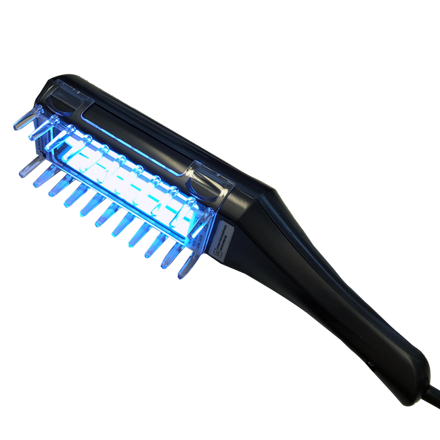
Dermalight® 80R
£379 (price at time of writing, October 2026)
Best for: the person who wants a certified German medical device they will use for years.
- CE-certified medical device made by Dr. K. Hönle Medizintechnik, Germany
- 4-year warranty on all parts – the longest of the four
- Lightest lamp here (about 285 g), so long sessions on the face or hands are comfortable
- LCD timer, comb attachment and UV goggles in the box
- The most expensive single lamp
- Treatment window 110 × 40 mm – larger areas take several positions
If you expect to use a lamp regularly for a year or more, the 80R is the one we recommend most often. The same Philips 311 nm tube as the others, but with medical-device certification, service and a warranty twice as long.
See the Dermalight® 80R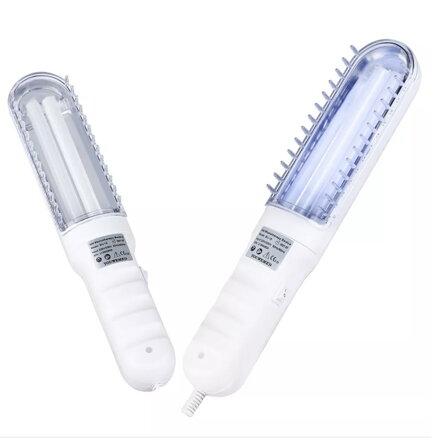
Philips BU-1S
£135 (price at time of writing, October 2026)
Best for: someone starting home phototherapy on small patches without a big investment.
- The most affordable genuine 311 nm narrowband lamp we sell
- Same Philips PL-S 9W/01 tube as lamps costing three times as much
- Simple controls, comb attachment and goggles included
- Our most-bought lamp in the UK – thousands of reviews across our shops
- Simple timer only – no dose setting in J/cm²
- Heavier than the Dermalight (about 480 g)
The BU-1S is the lamp most of our UK customers start with. It does the one thing that matters – deliver 311 nm light to the patch – and it does it at an entry-level price. If your vitiligo or psoriasis is on the face, hands, neck or a few small patches, it is all you need.
See the Philips BU-1S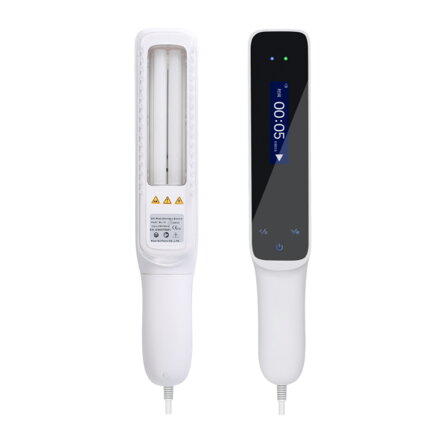
Philips BU-10
£245 (price at time of writing, October 2026)
Best for: anyone whose dermatologist prescribes doses in J/cm², or who is continuing a clinic protocol at home.
- LCD touchscreen: set the time (0–30 min) or the dose directly (0–5 J/cm²)
- Output adjustable from 0.3 to 20 mW/cm²
- Comb attachment and goggles included
- The heaviest lamp of the four (about 980 g)
- More settings than a beginner needs
The BU-10 is the only handheld lamp here that lets you dose in joules, exactly as an NHS phototherapy unit does. If you have a written dosing schedule from your dermatologist, this is the lamp that follows it.
See the Philips BU-10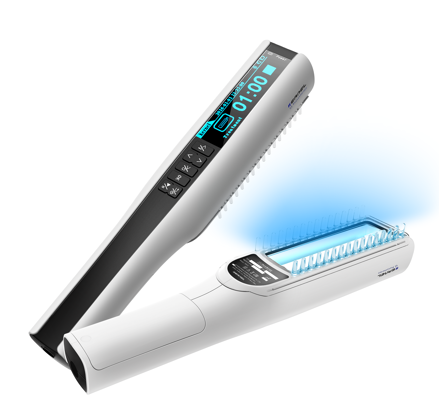
Kernel KN-4003BL2
£265 (price at time of writing, October 2026)
Best for: people who travel, or who want everything in one box with a clear display.
- OLED display with timer up to 30 minutes
- 100–240 V power supply – works abroad without a converter
- Removable comb, UV goggles and mains adapter all included
- Treatment area about 55 cm², IP22 rated
- Less well known brand in the UK than Philips or Dermalight
- Mid-range price
The Kernel is the “nothing else to buy” lamp. The 100–240 V supply is a real advantage if you spend time outside the UK, and the display makes it easy to keep sessions consistent.
See the Kernel KN-4003BL2Comparison table
| Feature | Philips BU-1S | Philips BU-10 | Kernel KN-4003BL2 | Dermalight® 80R |
|---|---|---|---|---|
| Our pick | Best value | Best for dosing | Best kit & travel | Best overall |
| Wavelength / tube | 311 nm, Philips PL-S 9W/01 | 311 nm, Philips 9 W NB-UVB | 311 nm ± 3 nm, Philips PL-S 9W/01 | 311 nm, Philips PL-S 9W/01 |
| Timer / dosing | simple timer | LCD touchscreen, 0–30 min or 0–5 J/cm² | OLED display, up to 30 min | LCD timer |
| Treatment area / output | irradiance ≥ 7 mW/cm² | 0.3–20 mW/cm² | about 55 cm² | 110 × 40 mm (44 cm²) |
| Comb / goggles | yes / yes | yes / yes | yes (removable) / yes | yes / yes |
| Weight | about 480 g | about 980 g | not stated | about 285 g |
| Power | UK plug, 230 V | UK plug, 230 V | UK plug, 100–240 V | UK plug adapter, 230 V |
| Manufacturer | YouWeMed | YouWeMed | Kernel Medical Equipment | Dr. K. Hönle Medizintechnik, Germany |
| Warranty | 2 years | 2 years | 2 years | 4 years |
| Price (Oct 2026) | £135 | £245 | £265 | £379 |
| Product page | BU-1S | BU-10 | Kernel | Dermalight 80R |
Specifications are taken from the manufacturers and our product pages; prices are correct at the time of writing and may change – the product page always shows the current price. For a deeper, feature-by-feature discussion read How to choose a home UVB lamp for vitiligo.
UVB lamps to avoid
Red flags on marketplace listings: no wavelength stated, or “UV lamp” / “UVA” / “254 nm” in the description; no timer; no brand of tube; a price under £60; listings that mix “tanning”, “nail curing” or “sterilising” in the same product. UVC sterilising lamps in particular can cause painful eye and skin injury within minutes and have no role in vitiligo or psoriasis.
Sunbeds are not a cheaper alternative either: they emit mostly UVA, which tans the surrounding skin (making patches more visible) without the melanocyte-stimulating effect of 311 nm light, and they raise skin-cancer risk.
Handheld lamp or NHS phototherapy?
Both use the same narrowband UVB. The NHS route means a referral, a course of 2–3 visits a week for several months and a full-body cabinet – ideal for widespread disease, but hard to fit around work and often with a waiting list. A handheld lamp costs about the same as a few months of travel to a clinic and lets you treat small areas on your own schedule for years. The British Association of Dermatologists guideline on vitiligo (2021) lists NB-UVB as a first-line option for active or widespread non-segmental vitiligo, and many UK dermatologists are happy to supervise home phototherapy – ask yours.
UVB lamps for psoriasis
Plaque psoriasis responds to the same 311 nm light, often faster than vitiligo: plaques usually thin and fade within four to eight weeks of regular sessions. The scalp, elbows and knees are the classic targets for a handheld lamp. Our customers typically pair the lamp with Psoriva oil applied about 30 minutes before each session, or start with the Psoriasis Starter Kit. Browse everything for psoriasis in our psoriasis range.
How to use a home UVB lamp safely
- Talk to your GP or dermatologist first, especially if you take medicines that increase sun sensitivity, are pregnant, or have had skin cancer.
- Prepare the skin. Clean, dry skin; for vitiligo many of our customers apply Vitistop Gel about 30 minutes before the session.
- Start low. 15–30 seconds per patch, lamp touching the skin via the comb or held at the distance in the manual. Increase by 10–15 seconds every session only if there was no redness the next day.
- Two to three sessions a week, at least 48 hours apart. Mild pinkness that fades within 24 hours is the target; redness that lasts means skip the next session and go back a step.
- Protect the eyes with the goggles whenever you treat the face, and keep eyes closed.
- Be consistent. First repigmentation usually appears after one to four months – follow our day-by-day treatment plan and photograph the patch monthly.
Not sure which lamp suits your patches? Tell us where your vitiligo or psoriasis is and how large the area is – we reply within one working day with a recommendation. Free DHL Express delivery across the UK, 14-day returns.
Shop all UVB lamps Ask us which lampFrequently asked questions
Which UVB lamp is best for vitiligo?
For most people a handheld 311 nm narrowband UVB lamp is the right choice. If you want the lowest price, the Philips BU-1S; if you want a certified medical device with a 4-year warranty, the Dermalight 80R; if your dermatologist doses in J/cm², the Philips BU-10. All four lamps in this guide use the same Philips 311 nm tube, so the light itself is the same – the differences are in dosing, build, accessories and warranty.
Which UVB lamp is best for psoriasis?
The same 311 nm narrowband lamps are used for plaque psoriasis. A comb attachment matters more for psoriasis because the scalp is so often affected – all four lamps here have one. Many psoriasis customers start with the Philips BU-1S or the Psoriasis Starter Kit, which pairs the lamp with Psoriva oil and PsoriaStop capsules.
Is a cheap UVB lamp from a marketplace as good as a Philips or Dermalight?
Only if it is a genuine 311 nm narrowband lamp with a Philips (or equivalent) NB-UVB tube, a timer and a stated irradiance. Many cheap “UV lamps” are UVA, broadband UVB or even UVC germicidal lamps, which do not help and can burn the skin or damage the eyes. If the listing does not state 311 nm and the tube type, do not buy it.
Do I need a full-body UVB cabinet instead of a handheld lamp?
A handheld lamp is designed for localised patches – face, hands, neck, elbows, knees, scalp. If more than roughly 20 % of your body is affected, ask your GP about referral to an NHS phototherapy unit; a handheld lamp can still be useful for the areas you want to prioritise.
How often and how long should I use a UVB lamp?
Typically two to three sessions a week with at least 48 hours between them. Start with 15–30 seconds per patch and increase slowly, only while the skin stays free of redness. First signs of repigmentation often appear after one to four months; psoriasis plaques usually respond faster. Keep a simple diary of dates and times.
Are home UVB lamps safe?
Narrowband UVB at 311 nm is the wavelength dermatologists use precisely because it has the best balance of effect and safety. The risks are sunburn-like redness from overexposure and eye damage without goggles, so follow the dosing schedule, wear the goggles and treat only the patches. Talk to your GP or dermatologist first if you take photosensitising medication, are pregnant or have a history of skin cancer.
Read next
- How to choose a home UVB lamp for vitiligo – detailed feature comparison
- UVB phototherapy for vitiligo: how light treatment works
- Vitiligo by body area: hands, face, fingers, neck
- Customer results with UVB lamps and Vitistop
Sources: NHS – Vitiligo treatment; Eleftheriadou V. et al., British Association of Dermatologists guidelines for the management of people with vitiligo 2021; NHS – Psoriasis treatment (phototherapy); DermNet – Narrowband UVB phototherapy.
This article is general information, not medical advice. Home phototherapy should be discussed with your GP or dermatologist. Our products support skin care alongside the treatment your doctor recommends; results vary from person to person.