.jpg)
Vitiligo on fingers and fingertips: what helps and how to look after them
White fingertips, pale knuckles or a light patch creeping around a fingernail – vitiligo on the fingers is very common, and because we use our hands all day, it can feel impossible to forget about. Fingers are known as the area that takes longest to respond, so this guide focuses on what you can do: a realistic routine, good protection for the skin and camouflage that lasts.
- Fingers, fingertips and knuckles are among the most typical places for vitiligo (NHS, DermNet).
- Patches on the lips together with the fingertips are a recognised pattern called lip-tip or acrofacial vitiligo.
- Fingertips have very few hair follicles – the main source of returning pigment – so they need the longest, most consistent treatment.
- Protecting fingers from friction and small injuries helps prevent new patches.
- A self-tanning mousse gives fingers a natural colour that survives hand washing.
Why vitiligo likes the fingers
Vitiligo is an autoimmune condition in which pigment cells are lost. It tends to appear in places exposed to friction and frequent small injuries – and few parts of the body work as hard as our fingers. Typing, gripping, washing, cooking and gardening all add up. In people prone to vitiligo, this repeated stress can trigger new patches, which doctors call the Koebner phenomenon. Patches on the fingers are often symmetrical, appearing on both hands at the same time.
Why fingertips are slower to repigment – and why it is still worth it
When vitiligo repigments, the colour usually comes back from pigment cells stored in hair follicles, appearing as small brown dots that spread and join up. The fingertips and the palm side of the fingers have almost no hair follicles, and the British Association of Dermatologists notes that the hands and feet generally respond less well than the face and trunk. In practice this means:
- the backs of the fingers and the knuckles, which do have fine hairs, usually respond before the fingertips;
- pigment on the fingers often returns from the edges of a patch inwards;
- treatment should be judged over many months, with photos every four weeks.
Slower does not mean impossible – our customers' photos show that fingers can repigment too.
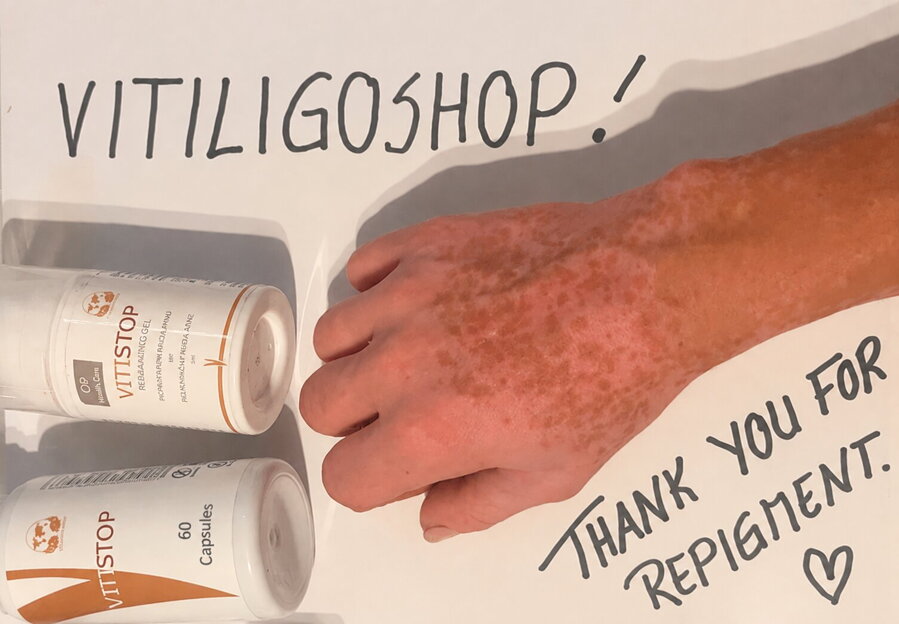

Treatment options for fingers
Your GP or dermatologist will usually start with a prescription cream – typically a potent steroid cream for a limited time or tacrolimus ointment. If that is not enough, the next recommended step is narrowband UVB (311 nm) light. A handheld lamp is particularly well suited to fingers: the area is small, and you can treat both hands in a few minutes at home two to three times a week.
A routine many of our customers follow:
- Apply Vitistop Gel to the fingers and knuckles and wait about 30 minutes.
- Treat with a 311 nm lamp such as the Philips BU-1S or Philips BU-10, two to three times a week with at least 48 hours between sessions. Start with a very short exposure and increase it only if there is no redness. Spread your fingers so the sides are treated too.
- Take one Vitistop tablet a day – copper contributes to normal skin pigmentation.
- Keep going through the slower phases – fingers reward consistency more than any other area.
The full routine, week by week, is in our day-by-day treatment plan.
Protect your fingers every day
- Gloves for washing up, cleaning, DIY and gardening.
- No picking or biting around the nails and cuticles – small wounds can trigger new patches.
- Rings that fit loosely and do not rub in the same spot.
- Moisturiser after washing to keep the skin supple.
- Sunscreen on the backs of the hands and fingers in sunny weather – white skin burns quickly. See our sun protection.
Covering vitiligo on fingers
Make-up rarely survives on fingers, because we wash our hands so often. A self-tanning product works much better. Apply Vitistop Self-Tanning Mousse with the Mini Mitt – or a cotton bud for knuckles and around the nails – and the colour usually lasts five to seven days. Wash the palms afterwards so they do not take on colour. Other options are in our camouflage range.
Questions about vitiligo on your fingers? Write to us – Peter, who has lived with vitiligo since 2016, and his team will be happy to help.
Home UVB lampsCustomer resultsFrequently asked questions
Why is vitiligo on the fingertips so hard to treat?
Returning pigment usually comes from pigment cells in hair follicles. Fingertips have almost no hair follicles, so repigmentation there is slower than on the face, neck or the backs of the hands. It is still possible, but it needs consistent treatment over many months.
What is lip-tip vitiligo?
Lip-tip (or acrofacial) vitiligo is a recognised pattern in which white patches appear on the lips and the fingertips, sometimes also on the toes. It is managed in the same way as other non-segmental vitiligo.
Can I use a home UVB lamp on my fingers?
Yes – a handheld 311 nm narrowband UVB lamp is well suited to small areas like the fingers. Start with very short sessions, increase gradually only if there is no redness, protect your eyes and follow the instructions supplied with the lamp.
How do I stop vitiligo spreading on my fingers?
Reduce friction and small injuries: wear gloves for chores, avoid picking at cuticles, keep rings loose and protect the skin from sunburn. Starting treatment early, while patches are new, gives the best results.
How can I cover vitiligo on my fingers?
A self-tanning mousse applied with a mini mitt or cotton bud gives a natural colour that does not wash off when you wash your hands and usually lasts five to seven days.
Vitiligo on other parts of the body
Sources: NHS – Vitiligo; Eleftheriadou V. et al. British Association of Dermatologists guidelines for the management of people with vitiligo 2021, Br J Dermatol 2022; NICE TA1140 – ruxolitinib cream for non-segmental vitiligo (March 2026); DermNet – Vitiligo.
This article is general information, not medical advice. Vitiligo should be diagnosed by a GP or dermatologist, and any new or changing skin patch is worth showing to a doctor. Our products support skin care alongside the treatment your doctor recommends.