.jpg)
How long does vitiligo repigmentation take? A realistic timeline with UVB 311 nm
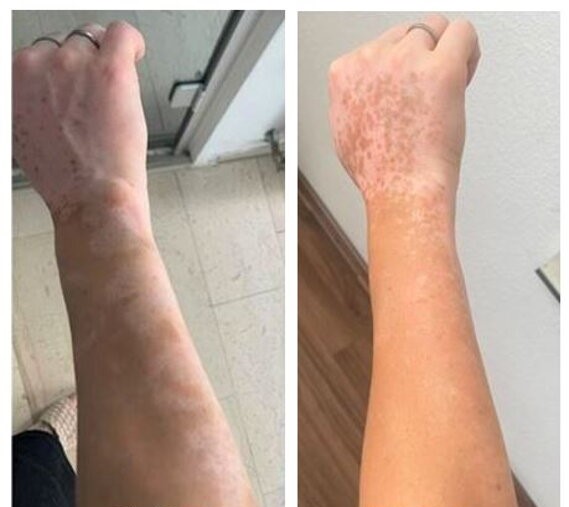
“How long will it take?” is the question we hear most often from people starting light therapy for vitiligo. The honest answer: longer than most people expect, but the progress follows a fairly predictable pattern. Here is what usually happens month by month with narrowband UVB 311 nm, what the studies say, and how to tell early on whether your treatment is working.
At a glance
- With 2–3 sessions a week, the first brown dots usually appear after 8–12 weeks (about 20–30 sessions).
- Clearly visible change typically comes after 3–6 months, the best results after 9–12 months.
- The face and neck respond fastest. Hands, feet and lips are the slowest, often 12–24 months.
- European guidelines advise reviewing the treatment if there is no repigmentation after 3 months, or less than 25% after 6 months.
- The most common reason for disappointing results is stopping too early, not the lamp.
Month by month: what to expect
The timeline below assumes non-segmental vitiligo, a handheld or full-body 311 nm lamp and two to three sessions a week on fixed, non-consecutive days. Every person is different, but this is the pattern dermatologists see most often.
| Period | Sessions | What you typically see | What to do |
|---|---|---|---|
| Weeks 1–4 | 8–12 | No new colour yet. A light pink tint a few hours after a session is normal and shows you are close to the right dose. | Start with the shortest time from the instructions and increase slowly. Keep the same days every week. |
| Weeks 5–12 | 12–30 | The first small brown dots around hair follicles, or a darker rim at the edge of a patch. | Take photos once a month in the same light and from the same distance. |
| Months 3–6 | 30–70 | The dots grow and merge into islands of colour, usually first on the face and neck. | Review progress with your dermatologist around month 3. |
| Months 6–12 | 70–130 | Larger areas fill in on the body, arms and legs. Patches get smaller and their edges blur. | Carry on as long as there is visible progress. |
| Months 12–24 | 130+ | Slower gains, mainly on hands, feet, elbows and knees. Results often reach a plateau. | Agree with your doctor on maintenance or a gradual reduction. |
Repigmentation almost always starts in the hair follicles, because that is where the reserve of pigment stem cells sits. That is why the first sign is not a fading of the white patch but tiny brown dots inside it, a pattern called perifollicular repigmentation.
What the studies say
The largest analysis of light therapy for vitiligo (Bae et al., JAMA Dermatology 2017) pooled dozens of studies and looked at how many people reached a given level of repigmentation with narrowband UVB:
- After 6 months: about 6 in 10 people had at least 25% repigmentation and about 1 in 5 reached 75% or more.
- After 12 months: about 3 in 4 had at least 25% repigmentation and roughly 1 in 3 reached 75% or more.
- The face and neck responded much better than the trunk and limbs, while hands and feet responded the least.
In other words, time is the strongest factor. Many people who see little change after 3 months end up with a good result at 12 months, provided they keep going. The European Dermatology Forum guidelines (Taïeb et al. 2013) therefore recommend judging the treatment only after several months: if there is no repigmentation at all after 3 months, or less than 25% after 6 months, the plan should be reviewed with a dermatologist.
Why some patches respond faster than others
- Location. Areas with many hair follicles (face, neck, trunk) have a large pigment reserve. Hands, feet, lips and bony areas have few follicles and respond slowly.
- White hairs. If the hair in a patch has turned white, the follicle reserve is often exhausted and repigmentation is much slower.
- How long the patch has been there. Newer patches usually respond faster than patches that have been white for many years.
- Activity of the disease. While vitiligo is still spreading, new patches can appear next to the ones that are regaining colour. More in Active or stable vitiligo? How to tell it is spreading, and what that changes in treatment.
- Regular sessions. Long breaks slow progress down or partly reverse it. Two sessions every week beat four sessions one week and none the next.
- Other conditions. Thyroid disorders are common with vitiligo and worth checking, see Vitiligo and the thyroid: why you should have TSH and antibodies checked.
How to tell early that the treatment is working
- Photograph your patches before the first session and then once a month, always in daylight, from the same distance and angle.
- Look for dots, not for fading. Small brown points inside a patch or a darker rim around it are the first signs of success.
- Write down your sessions. A short note of the date and time helps you and your doctor see whether the dose and regularity are right.
- Compare month 3 with month 0, not week 6 with week 5. The changes are too slow to notice from day to day.
How to give yourself the best chance
Light therapy works best as a routine you can keep up for months. In practice this means:
- Fixed days, for example Monday, Wednesday and Friday, with at least one day between sessions. A home UVB 311 nm lamp lets you do this in a few minutes without travelling to a clinic.
- Treatment from your doctor. Creams such as tacrolimus or ruxolitinib are often combined with light and can speed up repigmentation, especially on the face.
- Skin care before the session. Vitistop Gel is applied to the white patches 30–60 minutes before the light. It contains plant extracts with natural psoralens that make the skin more responsive to light, so start with shorter sessions and increase gradually.
- Support from inside. Vitistop tablets contain copper, which contributes to normal skin pigmentation, and are taken daily for the whole course.
- Protecting healthy skin. Use sunscreen on the surrounding skin outdoors, so the contrast does not grow.
A complete routine step by step is in our treatment plan. If you are deciding between a home lamp and a clinic, compare the options in UVB 311 nm or excimer 308 nm: which light is better for vitiligo?. Real progress photos from our customers are on the page Your results.
When to see a dermatologist
- new patches keep appearing or existing ones grow quickly,
- a session causes painful redness, blisters or burning,
- there is no repigmentation at all after 3 months of regular sessions,
- repigmentation is below 25% after 6 months,
- the result has stopped improving and you want to plan maintenance.
Want advice on where to start? Tell us where your patches are and for how long – we reply within one working day with a concrete suggestion.
Write to us UVB lamps 311 nmFrequently asked questions
How many UVB sessions does it take to see the first results?
Most people see the first brown dots after 20 to 30 sessions, which is roughly 8 to 12 weeks with two to three sessions a week. On the face it can be sooner, on hands and feet later.
Which areas repigment the fastest?
The face and neck respond best, followed by the trunk, arms and legs. Hands, feet, lips, elbows and knees are the slowest because they have few hair follicles, which are the main source of new pigment.
Can I speed things up with longer sessions?
No. Sessions longer than recommended cause burns, and burnt skin can make vitiligo worse. The dose is increased gradually according to the instructions. Regular sessions over many months matter far more than the length of a single session.
Will the colour stay once it has returned?
In many people the regained colour stays, but vitiligo is a long-term condition and some people lose part of it within one to two years. Sun protection, regular check-ups and maintenance sessions, if your doctor recommends them, help to keep the result.
What if nothing changes after 3 months?
First check how regular your sessions were and whether the dose was right, then see a dermatologist. Guidelines recommend reviewing the treatment if there is no repigmentation after 3 months or less than 25% after 6 months. Often a cream is added, or the activity of the vitiligo is assessed.
Read next
Sources: Bae JM et al. Phototherapy for vitiligo: a systematic review and meta-analysis. JAMA Dermatol 2017; Taïeb A et al. Guidelines for the management of vitiligo: the European Dermatology Forum consensus. Br J Dermatol 2013; Eleftheriadou V et al. BAD guidelines for the management of people with vitiligo 2021. Br J Dermatol 2022; DermNet – Narrowband UVB phototherapy.
This article is general information and does not replace an examination or advice from a dermatologist. Our products support skin care alongside the treatment your doctor recommends, and results vary from person to person.