.jpg)
Active or stable vitiligo? How to tell it is spreading, and what that changes in treatment
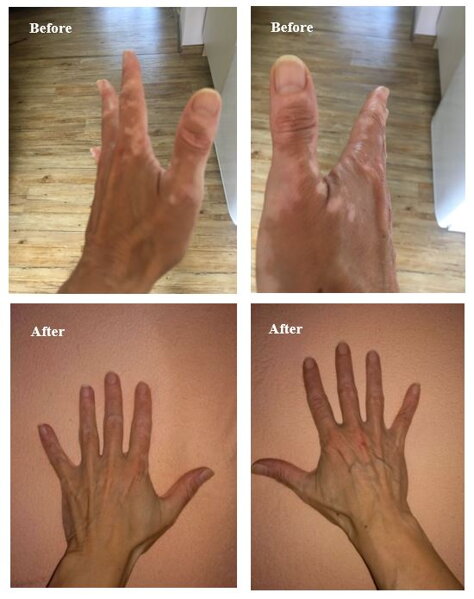
Most people judge their vitiligo by the size of the patches. A dermatologist asks something else first: is the disease active or stable? Active vitiligo means the immune system is destroying melanocytes right now – new patches are appearing or old ones are growing. Stable vitiligo is the state in which the extent of the patches has not changed for at least 6–12 months. The answer changes the order of steps: with active disease the spread must be stopped first, and only then is it worth investing time in repigmentation.
Four signs of active vitiligo you can see at home
The VETF task force and the 2017 consensus (Vitiligo Disease Activity Score, VDAS) describe several clinical signs that very probably indicate the disease is progressing. You do not need instruments to spot them – good light and photographs a few weeks apart are enough.
- Confetti-like depigmentation – tiny 1–5 mm white dots scattered around a patch or on healthy skin, as if someone had thrown confetti. This is the most specific sign of activity; in the study by Sosa et al. (JAAD 2015) it occurred almost exclusively in rapidly progressing vitiligo.
- The Koebner phenomenon – new patches exactly where the skin was mechanically irritated: under a watch strap, at the waist from a belt, on the knees after a fall, along a scratch, after a tattoo or sunburn. It occurs in 20–60 % of patients and shows that the immune system reacts to every skin injury.
- Trichrome vitiligo – a band of intermediate, light-brown colour between the fully white patch and normal skin. This “in-between step” means the melanocytes at the border are disappearing right now.
- An inflammatory (erythematous) border – a pink, slightly raised or itchy rim around the patch. It is rarer, but almost always means active disease.
Indirect signs add to these: new patches in the last 3 months, blurred, “faded” borders instead of sharp ones, and loss of pigment in the hairs on a patch (leukotrichia), which also means a poorer prognosis for repigmentation at that site.
How the dermatologist assesses activity
In the clinic a Wood’s lamp (365 nm UVA light) is used, under which patches without melanocytes glow chalk-white and confetti dots and blurred borders that escape daylight become visible. Extent is recorded with the VASI (Vitiligo Area Scoring Index) or VES score, activity with the VDAS or VIDA – the latter is simple: it rates whether new patches have appeared in the last 6 weeks, 3 months, 6 months or a year. The dermatologist also asks about associated autoimmune conditions (thyroid – see Vitiligo and the thyroid: why you should have TSH and antibodies checked), recent stress, infections and medicines, because vitiligo activity is usually tied to these triggers.
The first step in active vitiligo: stabilisation
For rapidly spreading vitiligo (new patches every month, confetti depigmentation, Koebner), the BAD 2021 and VETF guidelines recommend stopping the immune attack first. Options the doctor decides on:
- Oral mini-pulse corticosteroids – low doses of oral steroids (most often dexamethasone 2.5–5 mg) on two consecutive days a week for 3–6 months. In several studies this halted spread in 80–90 % of patients with acceptable side effects.
- Topical corticosteroids or tacrolimus on new patches – on the face and neck tacrolimus is first choice; on the trunk and limbs a potent steroid in an intermittent regimen (e.g. once daily for 3 weeks, 1 week off).
- JAK inhibitors – ruxolitinib cream (Opzelura) is approved in the EU and the UK for non-segmental facial vitiligo from age 12; systemic JAK inhibitors (upadacitinib, ritlecitinib) are in phase 3 trials and show they can both stabilise and repigment vitiligo.
- NB-UVB phototherapy – has a stabilising effect in its own right: in studies it halted progression in most patients within 3 months while already starting repigmentation. Combined with mini-pulse steroids it is more effective than either alone.
What you can do yourself until the vitiligo is stable
- Protect the skin from injury and friction – loose clothing, watch on the other wrist, no scratching, care during sport. With active vitiligo every injury is a potential new patch (Koebner).
- No sunburn – SPF 50 on the patches and around them; moderate, controlled sun or 311 nm light is fine, sunburn is a trigger.
- Have thyroid, B12 and vitamin D checked – untreated associated conditions keep the autoimmunity running.
- Stress – it cannot be “switched off”, but regular sleep and exercise demonstrably lower cortisol and oxidative stress, both involved in activating vitiligo.
- Photograph every 4 weeks in the same light and from the same distance – the only reliable way to know whether you are stable.
Stable vitiligo: when to start repigmentation and what to expect
When the extent of the patches has not changed for 3–6 months and no new ones appear, it is time to focus on bringing the pigment back. The foundation remains narrowband UVB 311 nm 2–3 times a week (the comparison with the 308 nm excimer is in UVB 311 nm or excimer 308 nm: which light is better for vitiligo?), combined on the face and neck with tacrolimus or ruxolitinib. Our customers add a psoralen gel before each session (Vitistop Gel) and daily support for the melanocytes with copper, zinc and L-tyrosine tablets (Vitistop tablets); the whole routine is in our treatment plan.
What decides the result: location (face and neck 70–80 % success, trunk 50–60 %, hands and feet under 30 %), hairs within the patch (the melanocyte reservoir), how long the patch has existed (fresh patches respond better) and consistency. For stable vitiligo that has not responded to light for at least a year, surgical methods come into consideration – melanocyte transfer or mini-grafts – which make sense precisely because in stable disease the transferred pigment is not destroyed by the immune system.
Not sure which phase you are in? Send us two photos a month apart and describe where your patches are – we will tell you what we would do first. Results from customers who have been down this road are in Your results.
Want advice on where to start? Tell us where your patches are and for how long – we reply within one working day with a concrete suggestion.
Write to us UVB lamps 311 nmFrequently asked questions
How long must vitiligo be stable before surgical treatment?
Most centres require at least 12 months without new patches and without enlargement of existing ones; some accept 6 months. In active disease the transferred melanocytes would be destroyed.
Can I use a UVB lamp while the vitiligo is spreading?
Yes, NB-UVB has a stabilising effect and the guidelines recommend it in active vitiligo, ideally combined with treatment from your dermatologist. Increase the dose carefully and avoid sunburn, which could trigger the Koebner phenomenon.
What does it mean when the hairs on a patch have turned white?
Leukotrichia means the melanocytes in the hair follicle, from which pigment regenerates, are destroyed too. Such a site responds poorly to light; combined or surgical treatment offers a better chance.
Is the Koebner phenomenon a reason to stop doing sport?
No. It is enough to limit repeated friction and small injuries at the same spot (tight straps, rough seams, kneeling without protection) and to be more careful while the disease is active. Exercise helps lower stress, which is itself a trigger.
Does stable vitiligo mean it will never spread again?
No, vitiligo runs in waves. That is why it is worth photographing the patches even after reaching stability and reacting early to the first new dots – fresh patches repigment most easily.
Read next
Sources: van Geel N et al. Development and validation of the Vitiligo Disease Activity Score (VDAS). Br J Dermatol 2022; Sosa JJ et al. Confetti-like depigmentation: a potential sign of rapidly progressing vitiligo. J Am Acad Dermatol 2015; Eleftheriadou V et al. BAD guidelines for the management of people with vitiligo 2021; van Geel N et al. Koebner phenomenon in vitiligo: European position paper. Pigment Cell Melanoma Res 2011; DermNet – Vitiligo.
This article is general information and does not replace an examination or advice from a dermatologist or endocrinologist. Our products support skin care alongside the treatment your doctor recommends; results vary from person to person.